Rubber Component Feeders Selection Guide
Choose rubber component feeders by comparing your parts, process, rate, access, data needs and required results.
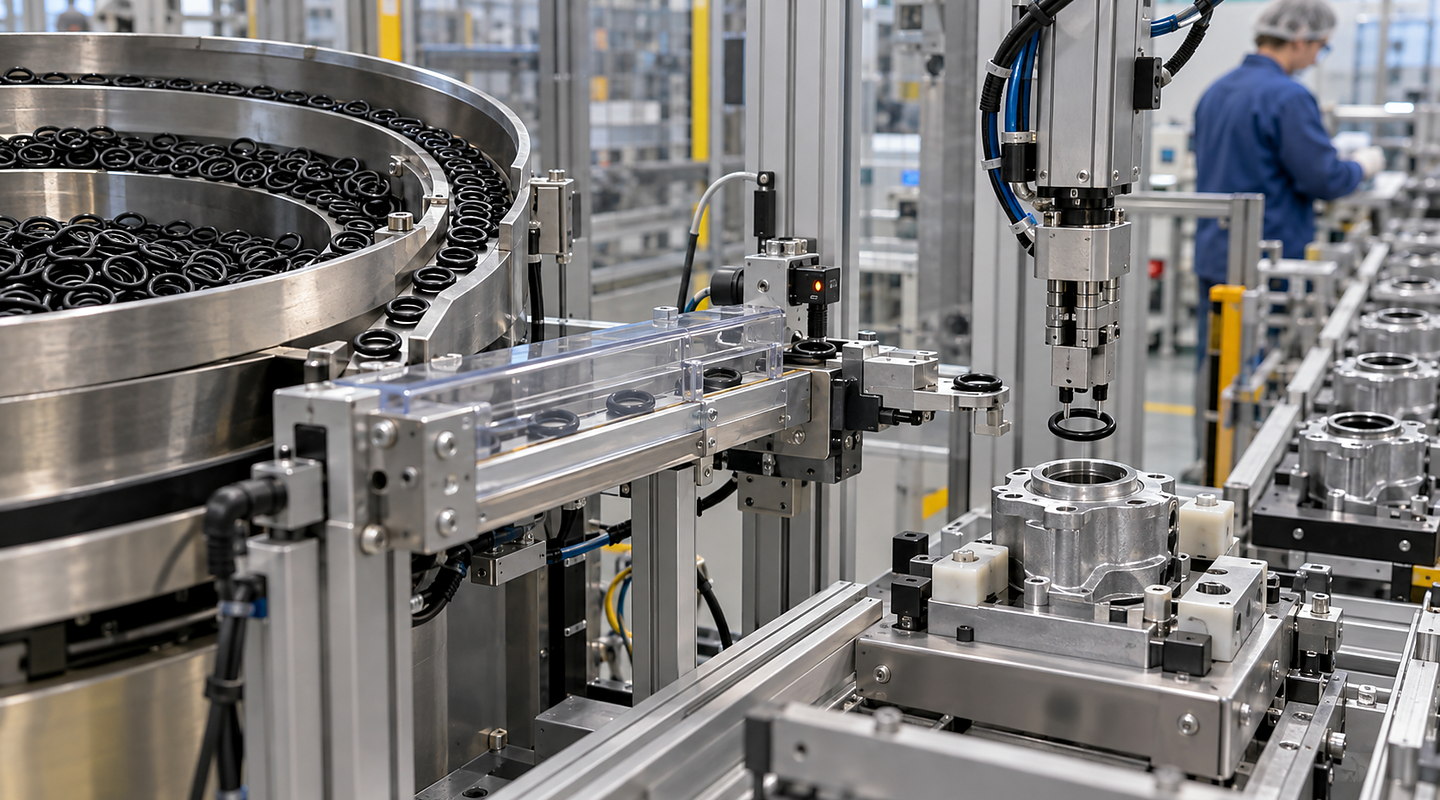
Select rubber-component feeding by trials with the real flexibility, surface condition and bulk behaviour. Compare separation, single-part orientation, transfer and release into the receiving fixture, including acceptable deformation and shape recovery.
If a bowl-feeding route is proposed, compare its full handling sequence with the flexible vision-guided or manual/tray routes using the same parts. No route is established by dimensions or nominal output alone; agree sustained delivery and condition checks.
Compare options in the conditions where they must work — Rubber Component Feeders
Plan rubber component feeders around real component variation, bulk condition, orientation, usable delivery rate and the downstream interface. Discuss representative part trials with Sorting Solutions. A useful shortlist should show how every option copes with component geometry and variation for flexible rubber-component feeding and escapement and downstream pick interface.
Discuss your application
Ask every supplier the same questions
| Decision | What to ask | What to check |
|---|---|---|
| Component Geometry and Variation for Flexible Rubber-Component Feeding | What normal range, extreme and rate of change applies to component geometry and variation for flexible rubber-component feeding? | Representative samples and a controlled trial. |
| Surface, Fragility and Entanglement Behaviour | What normal range, extreme and rate of change applies to surface, fragility and entanglement behaviour? | Representative samples and a controlled trial. |
| Bulk Condition and Replenishment Method | What normal range, extreme and rate of change applies to bulk condition and replenishment method? | Drawings, observation and interface measurements. |
| Required Orientation and Delivery Rate | What normal range, extreme and rate of change applies to required orientation and delivery rate? | Drawings, observation and interface measurements. |
| Escapement and Downstream Pick Interface | What normal range, extreme and rate of change applies to escapement and downstream pick interface? | Agreed operating and acceptance records. |
| Jam, Damage and Recovery Acceptance Checks | What normal range, extreme and rate of change applies to jam, damage and recovery acceptance checks? | Agreed operating and acceptance records. |
Include simpler approaches to flexible rubber-component feeding in your shortlist
| Approach | Often suitable when | Watch for |
|---|---|---|
| Rubber Component Feeders | You need a dedicated solution for a clearly defined duty, product or part range and line interface. | Sample trials must include normal, marginal and supplier-variant components. |
| Flexible Vision-Guided Feeding for Suitable Variable Part Families | A variable part family warrants a trial of flexible vision-guided presentation using the actual geometry, flexibility and surface-condition range. | Check separation, distinguishable single-part presentation, permitted contact and release; flexing or overlap may change the result at the receiving operation. |
| Manual or Tray Presentation where Bulk Feeding Would Damage Parts or Add Unjustified Complexity | Bulk contact causes unacceptable damage, distortion or attachment, or manual or tray presentation better fits the production requirement. | Compare accepted delivery, replenishment work, operator access and component condition using the same representative parts and downstream interface. |
Pause before choosing when…
- Only perfect or hand-selected examples of bulk presentation using flexible rubber-component feeding are available.
- No one has defined how jam, damage and recovery acceptance checks will be evaluated.
- The normal range for component geometry and variation for flexible rubber-component feeding is described only as “usually fine” but has not been bounded.
- Your operator, cleaning, maintenance or recovery access has not been considered.
- Quoted performance depends on another machine or data source that is not included.